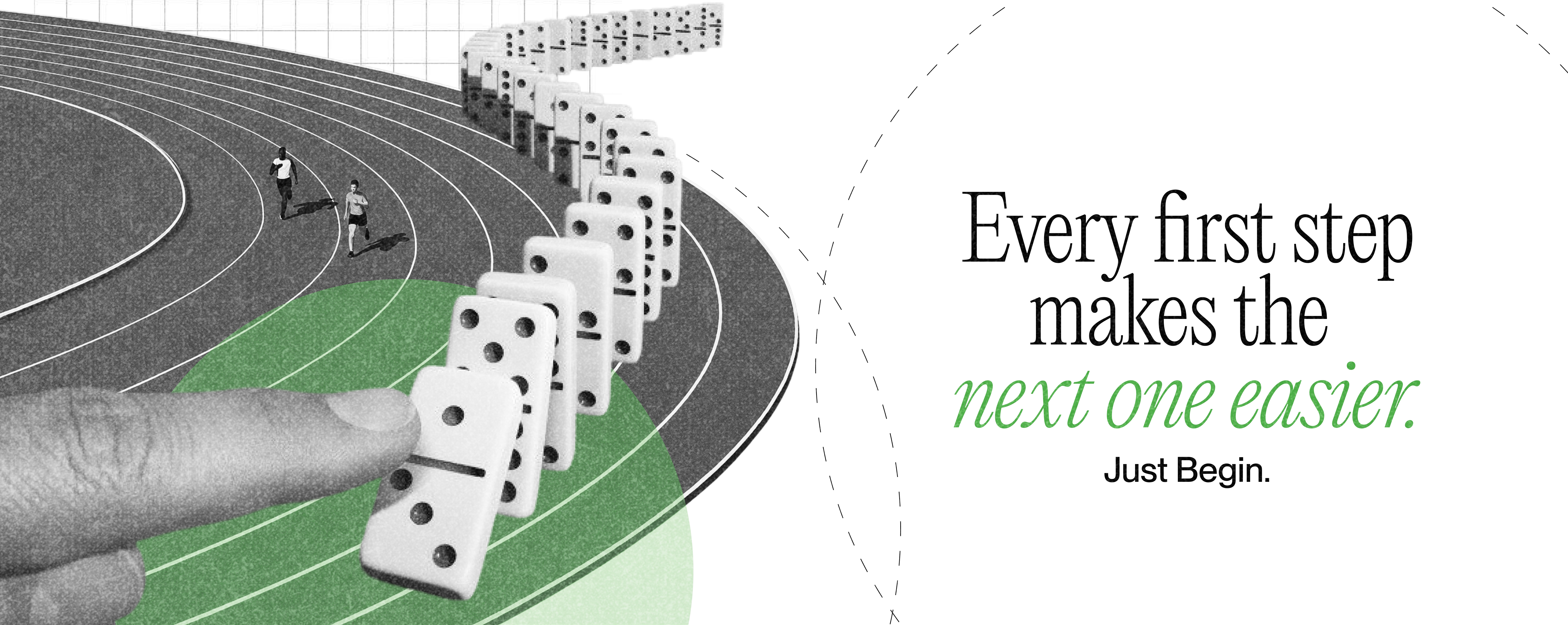
Picture a toddler in a park, pointing at every four-legged animal and yelling "dog." A golden retriever walks by, and the toddler nails it. A cat slinks past, and the toddler yells "dog" anyway, close enough for a two-year-old. A parent gently corrects it each time, "no, that one's a cat," and slowly, without ever explaining a single rule about ears, tails, or fur patterns, the toddler starts getting it right more often than wrong. Nobody ever sat this kid down and said "cats have retractable claws and dogs don't." The correcting alone did the teaching.
That's basically the entire idea behind a neural network. Feed a system thousands of labeled examples, this is a cat, this is not a cat, and let it guess. Every time it guesses wrong, it adjusts a few million tiny internal values, called weights, to improve its next guess.
Do that enough times, across enough examples, and the system starts recognizing cats it's never seen before. Nobody programmed in the rule for what a cat looks like. It got there entirely through being wrong, corrected, and adjusted, over and over, until the pattern stuck.
And that's how a neural network actually learns, whether it's identifying an animal, predicting the next word in a sentence, or recognizing a face in a photo. Once you look past the fancy math and terminology, it's just a system that learns through trial and error.
Now if you're wondering how to get into AI as a high schooler, you don't need to build that toddler's brain from scratch. Plenty of AI tools already come pre-trained, and using them is where you start.
Learning AI with no coding experience is more normal than it sounds
The idea that AI is only for people who've spent years coding first doesn't really hold up anymore. Most modern AI tools are built specifically so someone can train a model, build a chatbot, or run an image classifier through a visual interface or a few lines of pre-written code, without needing to understand every layer underneath it on day one.
Learning AI with no coding experience usually starts with tools that simplify the process. Google's Teachable Machine, for example, lets anyone train an image or sound classifier by simply uploading examples and clicking a button, no code required. It's an easy way to understand how AI learns from data.
The beginner AI path for teens: Where to actually start
A workable beginner AI path for teens usually follows a rough order: get curious first, get hands-on second, and only pick up the underlying math and code once there's a real reason to need it.
Step 1: Play with existing AI tools before building anything
Spend real time using tools like ChatGPT, Claude, and image generators, but pay attention to what they get wrong. Notice where a chatbot hallucinates a fact or where an image generator draws six fingers on a hand. That noticing is the beginning of understanding how these systems actually work.
Step 2: Build something small using no-code or low-code tools
AI for complete beginners becomes much easier with tools like Teachable Machine, Google's AutoML, and Hugging Face Spaces. They let you build and test a working AI model without writing full programs from scratch.
Step 3: Pick up just enough Python to customize things
Once no-code tools start feeling limiting, learning basic Python becomes the natural next step. It gives you the freedom to build bigger, more customized AI projects.
How long it actually takes to go from zero to a real AI project
A realistic timeline for getting started in machine learning as a teen looks something like four to eight weeks to build a first working project, assuming a few hours a week. That first project is usually small: a spam classifier, a basic image recognizer, or a simple recommendation tool built on a small dataset. It won't be groundbreaking, and it doesn't need to be. It just needs to work end to end, from raw data to a tangible result.
How much Math do you really need for AI?
Most beginners overestimate how much math is required before they can start. A working understanding of basic algebra and a comfort with percentages and averages is enough to get moving. Concepts like linear algebra, calculus, and probability matter more once someone is trying to understand why a model works, not just how to use one. You don't need advanced math on day one. Learn it as your understanding, and curiosity, grows.
Free resources worth using
- Google's AI for Everyone (via Coursera) for a plain-language overview of what AI actually does
- Teachable Machine for a genuinely no-code first project
- Andrew Ng's Machine Learning Specialization once basic Python is in place and the math starts becoming relevant
- Kaggle's free micro-courses, which pair short lessons with real datasets instead of toy examples
- fast.ai's Practical Deep Learning course, built specifically around the idea of building real projects before fully understanding the theory behind them
If you're figuring out how to get into AI as a high schooler, start with a small project. When you get stuck, learn the concept you need to move forward. Then go back to building. This makes new ideas easier to understand because you're learning them to solve a real problem.
FAQs
1. Can you learn AI without knowing how to code first? Yes. Plenty of beginner-friendly tools, like Google's Teachable Machine, let someone train a working model without writing any code. Basic coding becomes useful later, once a project needs more customization than a no-code tool allows.
2. What's the best way for a beginner teen to start learning AI? Start by using existing AI tools closely enough to notice their limitations, then move to a no-code project like Teachable Machine before picking up basic Python. Building something small early tends to teach more than reading about AI in theory first.
3. How long does it take to go from zero to building an AI project? Around four to eight weeks for a first small but genuinely working project, assuming a few hours a week. It won't be advanced, but it will be complete, from raw data to an actual working result.
4. What math background do you need to start learning AI? Basic algebra and comfort with percentages and averages is enough to begin. Deeper math like linear algebra, calculus, and probability becomes relevant later, once someone wants to understand why a model works rather than just use one.
5. Are there free resources for beginners to learn AI? Yes, plenty. Google's "AI for Everyone," Teachable Machine, Kaggle's micro-courses, and fast.ai's Practical Deep Learning course all offer a genuinely free, practical starting point for a complete beginner.
6. Should a beginner start with AI theory or hands-on projects? Hands-on projects first, almost always. Starting with a small project and learning theory only when it's needed to solve a real problem tends to stick far better than trying to absorb the theory upfront.
.png)
.png)
.avif)